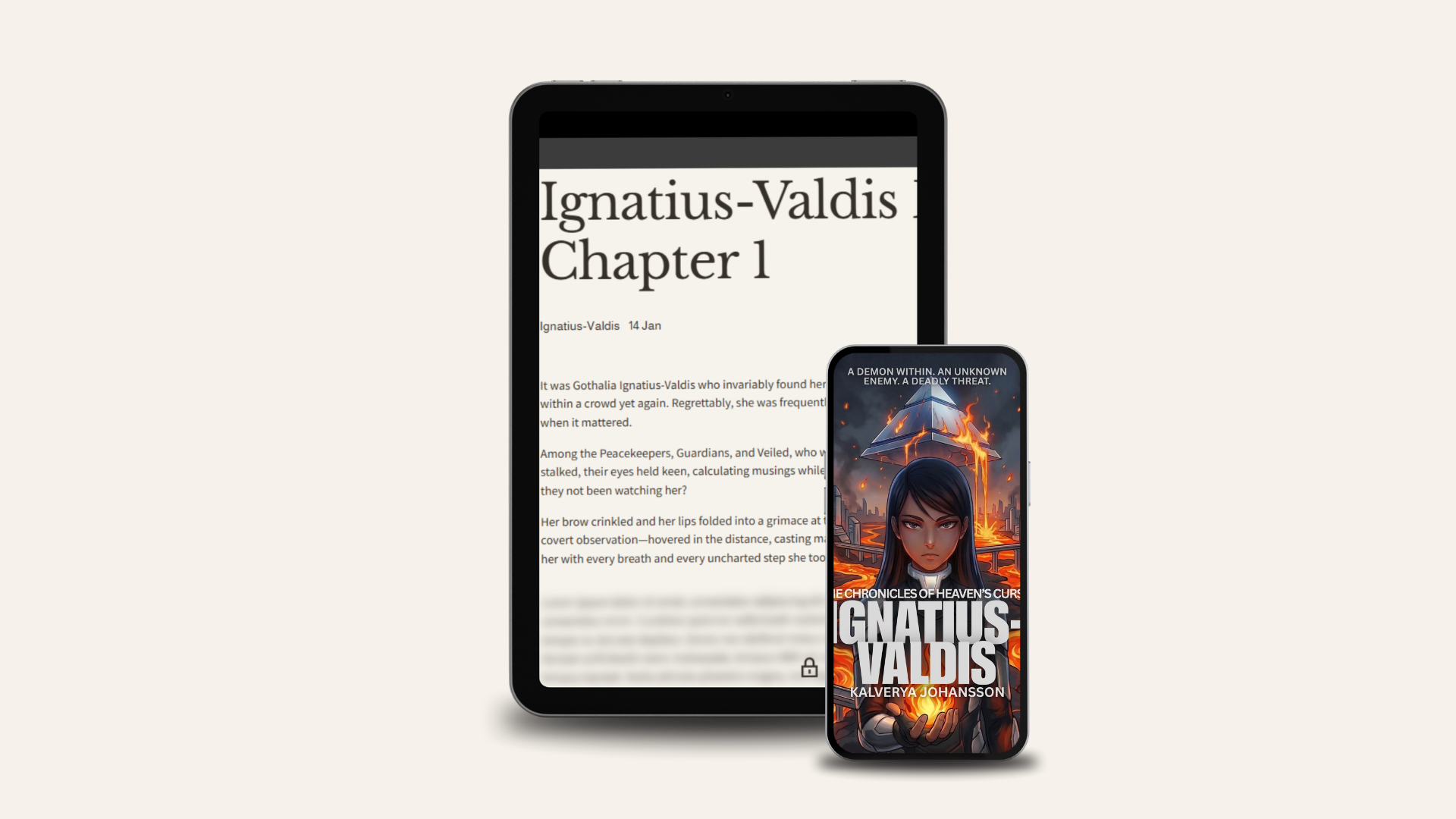
When I set out to write Ignatius‑Valdis, my aim was simple: build a world that feels lived in, intense in action, and intimate enough for readers to lose themselves inside the simulation. This tale speaks to a science‑fiction audience hungry for momentum—explosions, desperate gambits, and the clatter of boot‑heels on alloy decks—while also rewarding readers who want systems, lineage, and society to matter as much as the firefights. To achieve that balance I concentrated on three interlocked efforts: the mechanics of power, the texture of civilisation, and the emotional weight of conflict.
Central to the world are the Excelian Centurions of the Fire Reserve—soldiers honed to operate within a hostile simulation where a ravenous virus corrodes code and corpses alike. The Excelians are not a monolith. Their competency springs from distinct bloodlines, each with its own energetic logic and cultural identity. Angelus bloodlines channel lighter elements: luminosity, order, subtle radiances that can slice through chaos and stabilise collapsing systems. Deamone bloodlines lean into heavy elements: density, gravity, crushing force, the kind of power that reshapes terrain and shatters shields. Neutralus bloodlines exist to temper extremes; they blend heavy and light—or deliberately produce no element at all—to counterbalance, disrupt, or harmonise the other two.
I treated these energetic techniques as coherent martial arts with rules and costs. Offence and defence are two sides of the same disciplined practice: an Angelus flare can thread a beam through an enemy’s logic, but at the cost of draining stabilisers and attracting viral adaptation; a Deamone impact can punch through a corrupted barrier, yet risks destabilising nearby infrastructure. Neutralus interventions are rarely flashy—often clinical—but they are essential, the fulcrum on which large battles tilt. By making techniques consequential and integrated into logistics, rank, and ritual, the combat scenes gain weight beyond spectacle: every manoeuvre is a choice with cultural resonance.
Society in Ignatius‑Valdis mirrors those combat philosophies. The Excelians’ internal structure, propaganda, and rites reflect their elemental leanings: Angelus academies emphasise precision and ceremony; Deamone barracks favour endurance trials and blunt loyalty; Neutralus enclaves are laboratories for paradox and strategy. Outside the simulation, Humans on the Surface maintain a civilisational layer that both depends on and resents the Excelians. Surface culture supplies resources, moral mandates, and political pressure; in return, the Excelians provide protection and a kind of mythic purpose. I wanted that interdependence to feel uneasy and plausible: cooperation threaded through suspicion, necessity braided with exploitation.
Creating this world required small, specific details: how Angelus luminosity alters command language; the rituals Deamone soldiers perform before a gravity breach; the ways Neutralus mediators stanch social wounds after catastrophic misapplications of power. These particulars ground the high stakes of the narrative. Action scenes—centuries’ worth of training condensed into a single firefight—read as both technique and character revelation. The virus-simulated threats are more than environmental hazards; they interrogate the Excelians’ philosophies, forcing them to adapt or be unmade.
My aim was to design a setting that rewards repeated visits. Ignatius‑Valdis is tuned for readers who want adrenaline and schematics in equal measure: pulse‑pounding sequences underpinned by consistent worldbuilding, where lineage determines tactics, where civilisation shapes combat doctrine, and where every energetic flourish has consequences. This is the world I captured—a place where elemental ideology meets battlefield necessity, and where the question isn’t only who will survive, but how survival will change what people believe they are.
Whose Story Arc is Ignatius-Valdis?
Gothalia Ignatius-Valdis stands at the heart of a world split by elemental bloodlines and ancient doctrines. Born of Angelus and Deamone ancestry and marked by Neutralus lineage, she is an Excelian condemned by custom: her mixed blood spawned sliver fragments called Principalators, crystalline shards that can energise a Principalator — an utiliser of Midnight Eclipse. The Eclipse is a rare, perilous technique that bends both light and shadow; those who wield it gain tremendous power and terrible stigma. For Gothalia, the shards are both a tool and a curse, tying her fate to an ability society fears and forbids.
Her days are an unending negotiation between doctrine and necessity. Gothalia follows the tenets of her order to the letter, believing that discipline is her shield against the prejudice she endures. Yet discipline is not enough to quiet the internal conflict that comes with being three bloodlines in one body. Angelus impulses urge clarity and offensive precision, Deamone instincts pull toward heavy, decisive force, while Neutralus balance whispers compromise and restraint. The Principalators amplify these tensions, making every decision hazardous and every mission weighted by potential catastrophe.
The Excelians, as I imagined them, are not merely elemental practitioners but hybrid tacticians—centurions of the Fire Reserve who master both elemental and non-elemental energetic techniques. Their training is as much about physical endurance as it is about energetic literacy: learning to route luminosity, corral shadow, or dampen volatile currents until they become reliable tools. Gothalia’s mixed heritage, however, forces her to approach mastery differently. She cannot rely on pure lineage affinities; instead, she must invent syntheses, forging new routines that reconcile contradictory flows without shattering under stress.
Angelus bloodlines in this setting channel lighter elements—luminosity and order—using them for both defence and precise, blinding offence. Deamone lines harness heavy elements—gravity, pressure, density—turning raw force into tactical advantage. Neutralus families are the keepers of equilibrium, wielding a triage of heavy, light and neutral energies to counteract extremes and maintain social and energetic stability. Gothalia’s existence is a living critique of this separation: she embodies the possibility that synthesis can outpace segregation, even if society rejects the idea.
The civilisation surrounding these bloodlines is layered and purposeful. Excelians live in stratified citadels where technique, ritual and political rank intertwine; their centres are latticed with conduits for energy flow and guarded vaults for artefacts like Principalators. Beyond the citadels, Humans on the Surface maintain a wary, practical partnership with Excelian society—trading technologies, knowledge, and a begrudging respect for the centurions’ capacity for protection. I crafted this society to reflect how institutional fear can ossify into law: the condemnation of mixed bloods is not only superstition but policy, enforced by those who fear the unpredictability of synthesis.
Gothalia’s story is, above all, a narrative of tension—internal, social and metaphysical. Her journey interrogates doctrine and tests the limits of what an individual can reconcile when they are literally composed of conflicting natures. Fans of science-fiction action and adventure will find in her struggles the grit of frontline combat and the cerebral strain of mastering contradictory energies. The presence of Principalators and the Midnight Eclipse raises the stakes: power here is seductive and dangerous, and Gothalia must decide whether to accept a taboo that might save or doom those she swore to protect.
How Gothalia drives Ignatius-Valdis?
Gothalia Ignatius-Valdis propels the story by choosing how to act within each situation she faces. Characters steer narratives the same way she does: through their decisions. The interpersonal dynamics and inner journey of self-discovery engage both the character and the reader. Gothalia’s choices read like decisions sketched on a map of consequence: each step alters the terrain beneath her feet. When she confronts another person, she does not merely react—she negotiates identity. A conversation becomes a battlefield of memory and desire; a glance, an arrangement of possible futures. She listens for the gaps in other people’s sentences and fills them with her own quiet boldness, not to dominate, but to test the boundaries of who she is against who they say she should be.
Her agency is not loud. It is the precise, stubborn calibration of small acts—refusing a favor that costs her integrity, offering help when it risks exposure, deciding to leave a room rather than stay and be diminished. Those choices accumulate like ledger entries, accruing a portrait of moral currency that the reader watches compound. We trace the arithmetic of her life: what she keeps, what she sacrifices, what she invents to survive. In that arithmetic, the story obtains momentum because it is rooted in authenticity; Gothalia’s decisions feel inevitable because they follow an inner logic we come to understand intimately.
Interpersonal dynamics are where her internal life finds mirrors and contradictions. Friendships become instruments to reveal hidden anxieties: a confidant’s betrayal uncovers a buried fear; a lover’s indifference surfaces a secret yearning. Each relationship refracts a different facet of her character. Through confrontations and reconciliations, the narrative reveals not only who Gothalia is to others, but who she is to herself when no one else is watching. The reader, attuned to those shifts, experiences a double movement—observing external drama while participating in inner reckoning.
Self-discovery in Gothalia’s arc is less about sudden revelation and more about incremental recognition. She parses language, gestures, and silences as data points, forming hypotheses about her desires and testing them in small experiments: taking a job that conflicts with her principles, entering a city that reminds her of childhood losses, speaking a truth she has long muted. Each experiment either confirms or refutes her assumptions and reshapes subsequent choices. The narrative stakes are therefore psychological as well as situational; by making inner shifts visible through external action, the story sustains its forward drive.
The reader’s engagement hinges on empathy and curiosity. Gothalia’s agency invites us to judge and to imitate, to see how we might act under similar strains. As we map her decisions, we also map our own moral compass, comparing what we would do with what she does. That mirroring amplifies tension: sometimes we admire her resolve, sometimes we resent her timidity, and often we want her to make a different choice than the one she makes. Those conflicting responses keep us invested; we are not passive observers but co-conspirators, nursing hopes and anticipating missteps.
Finally, Gothalia’s choices are narrative engines because they produce consequences that ripple through plot and theme. A single decision can sever relationships, catalyze revelations, or unearth secrets that restructure the entire story. Her volition converts abstract themes—identity, loyalty, freedom—into causal chains. The reader follows not merely to see what happens next, but to understand how an individual’s inner life animates outward events. In that interplay, Gothalia embodies a fundamental truth of fiction: character is not just described; it performs. And through performance, the story becomes inevitable, earned, and human.
